
AI as a "Bullshit Job" Detector
Is your organisation busy, or is it productive? We’ve become remarkably skilled at optimising processes that shouldn’t exist.
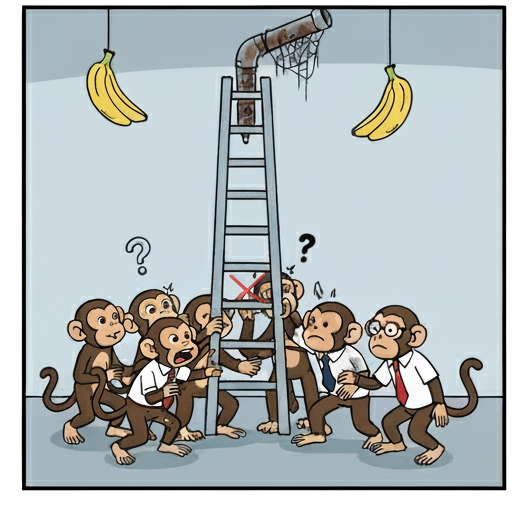
Is your organisation busy, or is it productive?
This is the only question that matters. Yet in many companies, activity masquerades as progress—decks get polished, reports churned out, dashboards blink—and all of it generates noise, not signal.
We’ve become remarkably skilled at optimising processes that shouldn’t exist.
I've noticed a powerful side effect of applying AI and automation is that it shines a cold, unforgiving spotlight. In the rush to automate a report, we often discover no one was reading it. In streamlining a workflow, we’re forced to admit the entire process is a fossil—an empty ritual long detached from any real purpose.
AI isn’t just a tool for efficiency. It’s a bullshit job detector. It is the long-overdue catalyst for a corporate overhaul. It forces leaders to stop fine-tuning the engine and ask the bigger question:
Should the car even be on the road?
This post looks at three motivators for identifying and eliminating three classes of organisational waste:
- The “No Output Division” – Teams that look productive on paper but deliver nothing of actual value.
- The “Wet Monkeys” Culture – The legacy rituals and conditioned behaviours that defend useless work.
- The “Cottage Spreadsheet Industries” – The sprawling, manual workarounds that exist because no one fixed the root cause.
1. Exposing the "No Output Division" - NOD and Nodders

The term "No Output Division" (NOD) was coined in a famous 1982 internal memo by legendary Digital Equipment Corporation (DEC) engineer, C. Gordon Bell. As DEC grew into the world's second-largest computer company, Bell became frustrated with the stifling bureaucracy and the proliferation of internal committees that seemed busy but contributed nothing to shipping actual products.
In a blistering memo to his engineering staff, Bell declared war on this inefficiency. He sarcastically proposed that all employees who weren't doing "real work" could be moved to a new group he named the "No Output Division (NOD)," where "they won't take time from people who have real work to do." He ended the memo with the pointed postscript: "I'm quite serious about NOD."
Bell's memo became legendary because it perfectly captured the critical distinction between mere activity (meetings, reports) and real output (tangible value). A "No Output Division" is any part of an organisation that excels at activity but produces no meaningful output, acting as a drain on resources and a drag on productivity. The term endures as a timeless warning for leaders to constantly question whether work is simply keeping people busy or actually creating value.
Bell's memo became an instant classic within DEC and, over time, in the wider tech and business world. It perfectly encapsulated a frustration that every leader in a growing organisation feels: the distinction between activity and output.
- Activity is being busy. It's attending meetings, writing reports, managing processes, and hitting internal KPIs.
- Output is delivering tangible value that the next person in the chain (whether an internal team or an external customer) wants and uses.
A "No Output Division" is any team, group, or process that excels at activity but produces no meaningful output. It is a cost centre in the truest sense, consuming resources while creating drag on the parts of the business that actually generate value.
The concept has endured because it's a powerful and precise label for a common organisational disease. It serves as a timeless warning for leaders to constantly ask the question: "Is this work contributing to our final product, or is it just keeping people busy?"
This is not a hypothetical problem. It is happening in your company right now. A development team is rewarded for writing thousands of lines of code that swamp the two senior engineers who are the actual bottleneck for quality review, bringing the delivery of real features to a halt. A marketing team hits its lead-generation targets by flooding the sales team with so much low-quality noise that the number of actual sales opportunities goes down.
These teams are not failing; they are succeeding at the wrong task. They are "no output divisions" because their work product is an unconsumed waste product.
Applying AI here isn't about helping them produce more useless code or more low-quality leads, faster. It is about asking the brutal question that AI’s implementation forces to the surface: If we automated this team's entire output, would anyone notice? If the answer is no, you haven't found an opportunity for automation; you have identified a corporate phantom limb that needs to be amputated.
2. Challenging the "Wet Monkeys" Culture
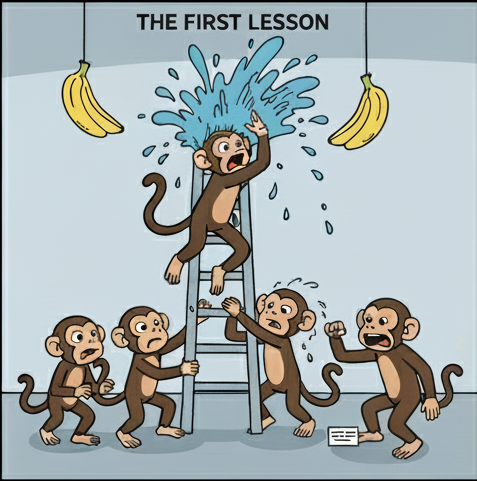
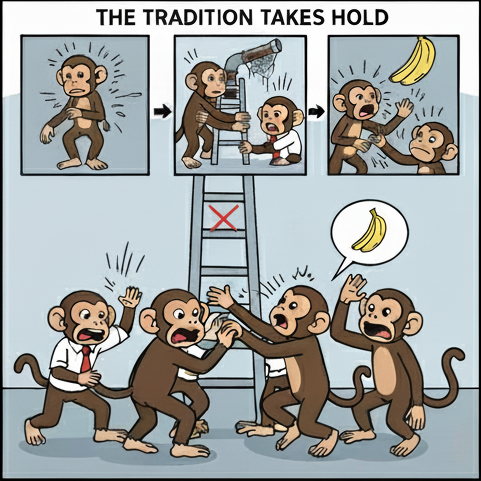
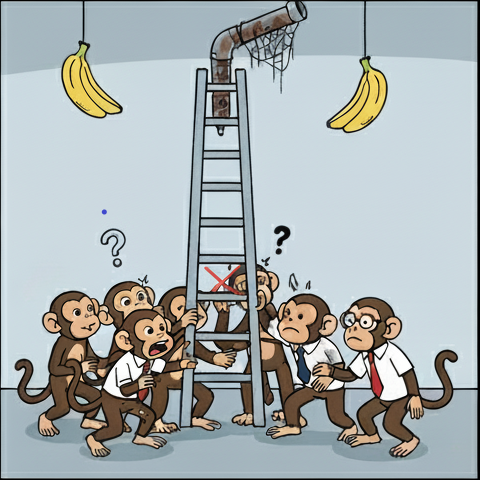
Why does this waste persist? Consider the "experiment"of the monkeys and the water spray. Scientists cage five monkeys with a ladder and bananas. When one climbs, all are sprayed with cold water. Soon, the monkeys police themselves, beating any monkey that attempts to climb. One by one, the original monkeys are replaced. The new monkeys, never having been sprayed, enthusiastically join in the beatings. Eventually, no monkey who was ever sprayed remains, yet all of them enforce a rule whose purpose is completely unknown.
This is your corporate culture. "That's the way we've always done it." This single phrase is the engine of institutional mediocrity. It is the justification for every redundant report, every pointless meeting, every workflow that exists only because of a forgotten, but possibly real, trauma from a painful experience a decade ago.
This is the cultural immune system that attacks progress. When you propose using AI to eliminate a manual, multi-day reconciliation process, you are not met with logic. You are met with the brute force of conditioned behaviour. The team whose identity is wrapped up in the heroic effort of that manual process will fight you, not because your solution is wrong, but because you are threatening to take their ladder away. They have forgotten why they fear the water, but they will defend the fear to the death.
"It is difficult to get a man to understand something, when his salary depends upon his not understanding it." -Upton Sinclair
The monkeys who have never been sprayed still prevent others from climbing the ladder. Their "salary"—their safety, social standing, and role within the group—depends on enforcing the rule. An employee whose job, expertise, and sense of value are tied to a redundant or inefficient process has a powerful incentive not to understand or admit that the process is obsolete.
The question AI forces upon leadership is no longer polite: Which of our sacred processes are nothing more than a ritual performed by monkeys who fear a water spray that no longer exists?
3. The cottage industry in spreadsheets
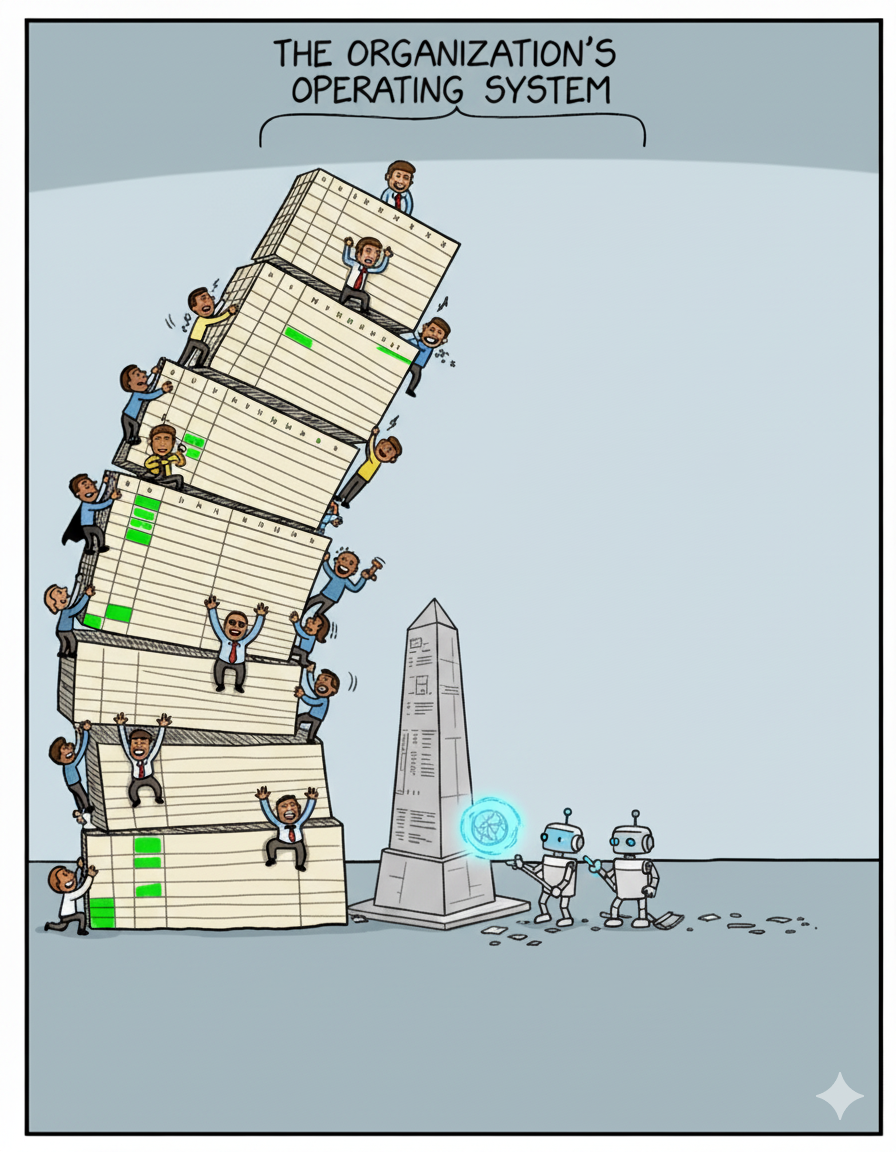
The rituals of the "spraying monkeys" culture create sprawling, hidden factories of inefficiency: the "cottage spreadsheet industries."These are not just innocent workarounds; they are a form of institutionalised technical debt. They are the thousands of disconnected, manually-intensive processes run on Excel or Google Sheets that exist as monuments to broken systems, siloed data, and a deep-seated resistance to change.
They are the shadow economy of your organisation, and they are actively costing you money, exposing you to risk, and strangling your ability to move faster than your competitors.
How to Spot Them
These hidden factories are not difficult to find once you know the symptoms. Look for:
- 🦸♀️The Hero: A single person, often a long-tenured employee, who is the only one who truly understands the master spreadsheet. They are praised as a "wizard" or "hero" for their ability to produce the critical report each month. This is not a sign of a great employee; it is a sign of a catastrophic single point of failure. Their departure would cripple the process.
- 📆The Monthly Ritual: A significant, recurring time sink where entire teams are pulled into the drudgery of manual data entry, reconciliation, and validation. The first three days of every month are a write-off for the finance team as they "wrestle with the numbers." This is not "the cost of doing business"; it is the cost of organisational inertia.
- 🍸Extreme Fragility: The process is notoriously brittle. A single copy-paste error, a deleted formula, or a change in an input file can corrupt the entire sheet, leading to hours or days of forensic work to fix it. The data is treated with a combination of reverence and terror.
- 💀The Data Graveyard: Data goes into these spreadsheets to die. It is instantly out of date, impossible to audit, and disconnected from any real-time source. Decisions are being made on static, error-prone snapshots of a reality that has already changed.
Here, AI and automation are not tools for improvement; they are weapons of destruction. The goal is not to help the team reconcile spreadsheets faster. The goal is to burn the spreadsheets to the ground. A proper AI implementation connects directly to the source systems, automates data ingestion, and renders the entire manual process obsolete.
This is the most valuable application of AI: not to automate the work, but to eliminate it. The moment you automate a report and discover no one needed it, you have achieved a far greater victory than mere efficiency. You have exposed a "bullshit job." You have revealed organisational scar tissue that can finally be removed.
The vital question is not "How can we do this faster?" but "Why the hell are we still doing this at all?"
Examples from the Field
These are not trivial administrative tasks. They often sit at the heart of critical business functions.
- Sales Commission Calculation: In many sales organisations, commission payouts are calculated on a monstrous spreadsheet that attempts to connect data from the CRM, finance systems, and HR. It is run by a lone analyst in sales operations, takes a week to complete, is opaque to the sales reps, and is a constant source of disputes and mistrust.
- Financial Planning & Analysis (FP&A): The classic example. A team of highly-paid analysts spends the first week of every month manually pulling data from twenty different departmental spreadsheets to consolidate a forecast. The process is so slow that by the time the forecast is ready, the month is half over and the data is already stale.
AI as the Forcing Function
The role of AI here is not to help these spreadsheets work better. It is not to automate the data entry or import the file faster. Its role is to act as a forcing function that makes the entire manual process obsolete.
A proper AI-driven approach doesn't just replicate the flawed process; it fundamentally challenges and replaces it. It connects directly to the source systems (CRM, finance, HR), ingests the data in real-time, and applies a clear, auditable, and consistent set of rules to produce the result. The cottage industry of manual validation, the monthly ritual of reconciliation, the dependence on the hero—all of it is rendered unnecessary.
This is the most valuable and aggressive application of AI: not just to automate the work, but to eliminate it by exposing the brokenness of the underlying process. The moment you try to automate a cottage industry, you are forced to confront the nonsensical rules and historical baggage that created it. You don't just get a faster report; you get organisational clarity through forced simplification.
The vital question is not "How can we do this faster?" but "Which of these hidden factories are you choosing to subsidise for another quarter?"
Resonates? Please reach out to start something new or ask for advice.